Published October 23, 2026
How to Identify Antique Rugs and Textiles From a Photo: Knots, Dyes and Origins
Why Photo Identification Works for Rugs and Textiles
An old rug on a floor, a folded kilim in a loft, or a quilt in a cedar chest can look anonymous until you know what to photograph. Age, origin, and value hide in the back of the weave, the fringe, the dyes, and the way the pattern was drawn. Those clues are visible in good photos—if you know which angles matter.
This guide is a practical walk-through for identifying antique rugs and textiles from a photo. You will learn how to tell handmade pile from machine-made copies, how regional designs point to Persia, Anatolia, the Caucasus, or Europe, how knot type and foundation date a piece, how natural dyes differ from later synthetics, and how quilts, tapestries, and samplers give up their own dating evidence. You will also get a shot list so tools like Antique ID can give you a useful first-pass identification and market range.
Photo identification is research, not a certified appraisal. A picture cannot prove fibre species, count every knot, or certify a museum-level attribution. Use it to sort inherited pieces, price a listing realistically, and decide when a textile specialist should see the object in person.
Handmade Versus Machine-Made: The First Split
The first question is not “Persian or Turkish?” It is whether the piece was knotted or woven by hand, or produced on a power loom. That split changes value more than almost any other tell.
Handmade pile rugs are built knot by knot on a warp. On the reverse you should see individual knots, slight irregularities in the drawing, and a pattern that does not repeat with mechanical precision. Sides (selvages) are usually overcast or wrapped by hand. Fringes are typically the continuation of the warp threads, not a strip sewn on afterwards.
Machine-made rugs (Wilton, Axminster, and later power-loom “orientals” from Europe, Egypt, and China) look too even. The back often shows straight, repeating rows rather than knot heads. Fringes are frequently stitched or glued onto a finished edge. Sides may be serged with a sewing-machine overlock. The same medallion can repeat identically down the field—something a village weaver almost never does.
Flatweaves complicate the split. A kilim, soumak, or dhurrie is handmade but has no pile knots. A Jacquard coverlet or Aubusson tapestry is woven, not knotted. Photograph the back and one corner before you decide the category. For a broader look at wear and construction across antiques, see how to identify antiques.
Oriental and Persian Rug Origins You Can Read From a Photo
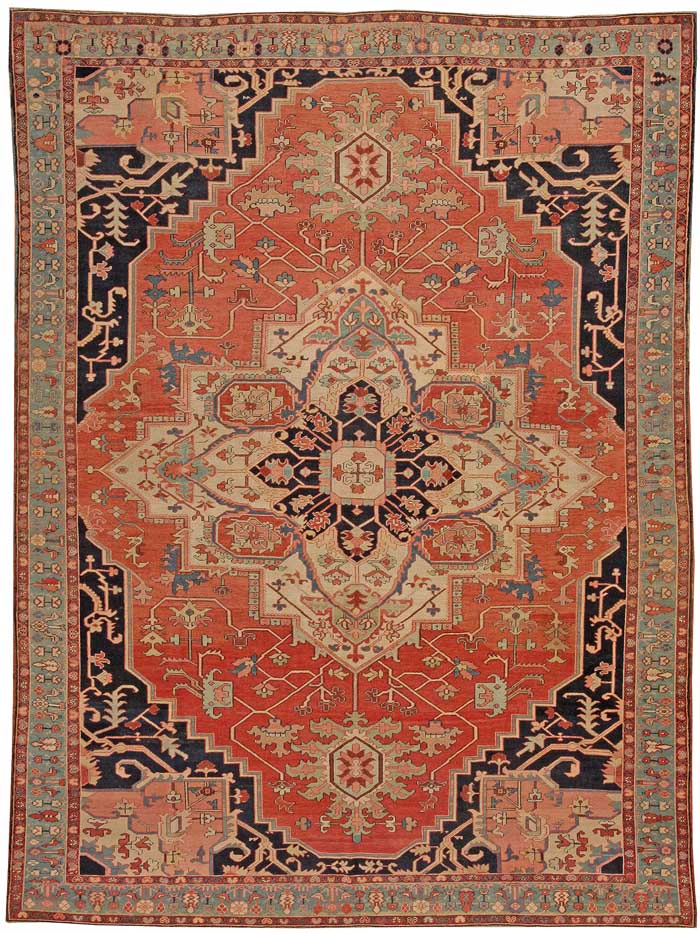
Dealers use “oriental rug” for handmade pile carpets from a wide belt: Iran (Persia), Turkey (Anatolia), the Caucasus, Central Asia, India, and China. Design language, palette, and drawing style are your first geographic clues. Treat these as working hypotheses—city workshops copied village designs, and later commercial weaves imitated famous names.
Northwest Persia — Heriz and Serapi. Bold geometric medallions, hooked leaves, and a sturdy wool pile. Serapi is a trade name for finer, earlier Heriz-type rugs, often with a more open field and clearer drawing. These are among the most recognised “room-size” antiques in Western interiors.
Tabriz, Kashan, Isfahan, Kerman. City workshop rugs tend toward curvilinear florals, hunting scenes, or central medallions with finer knotting. Tabriz can be very fine; Kashan often shows rich reds and navy; Isfahan is known for elegant vine-scroll drawing; Kerman later pieces sometimes use lavender and pictorial designs. Finer curvilinear drawing usually means a workshop, not a nomadic loom.
Tribal and village weaves — Qashqai, Bakhtiari, Kurdish, Afshar. Smaller formats, geometric animals or palmettes, stronger abrash (natural stripey dye variation), and wool foundations are common. The drawing is lively rather than courtly.
Anatolia — Oushak, Hereke, village prayer rugs. Oushak carpets often have large-scale palmettes and a softer, more open palette. Hereke and some silk prayer rugs are workshop-fine. Village Anatolian pieces show prayer niches (mihrab), latch-hook borders, and woollen foundations.
Caucasus — Kazak, Shirvan, Kuba. Saturated geometrics, latch hooks, and strong primary colours. Many survive as smaller rugs rather than palace carpets.
Turkmen — Tekke, Yomut, Saryk (“Bokhara” in the trade). Repeat gul medallions, deep red grounds, and tent-bag formats (juval, torba). “Bokhara” on a label is a market term, not a precise tribal ID.
India and China. Agra and Amritsar workshops produced large carpets, sometimes after Persian models. Chinese Ningxia and Peking rugs show Buddhist and Taoist motifs, fret borders, and a different wool character—often softer, with blues and golds.
Europe. French Aubusson (tapestry-woven, often pastel florals) and Savonnerie (pile, courtly) are not oriental rugs but sit in the same photo-identification workflow. English Arts and Crafts and Donegal carpets have their own drawing and wool.
A full overhead photo plus a border close-up is enough for a first regional guess. Confirm it against the back, the fringe, and the dyes before you treat the name as fact.
Reading Knots, Foundation, and the Back of the Rug
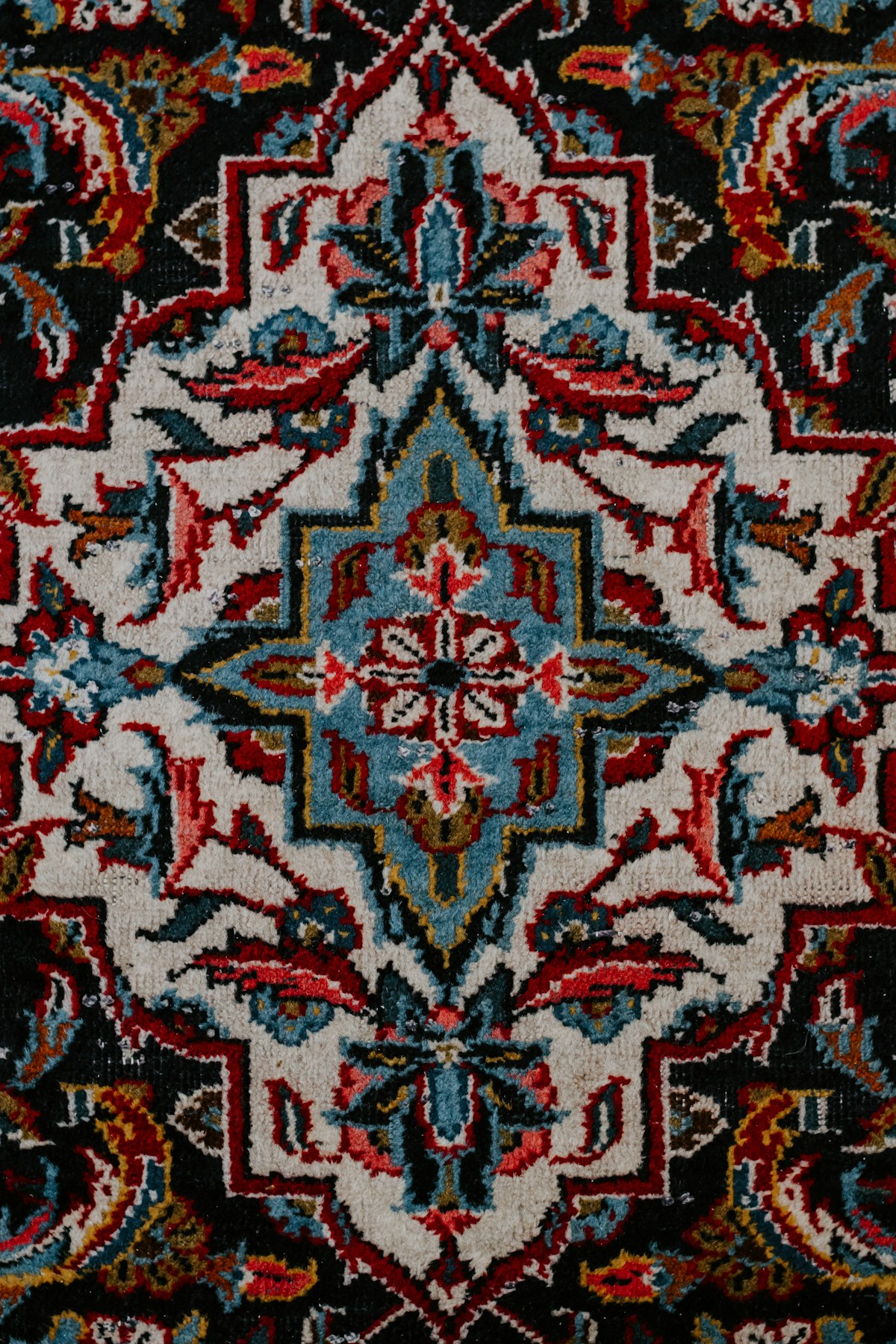
Turn the rug over. The back is where identification gets serious. Photograph it in raking light so knot heads and repairs cast shadows.
Asymmetrical (Persian / Senneh) knot. The yarn wraps one warp fully and loops the neighbour. Common on many Persian city and some tribal rugs. In a macro photo the knot heads can look slightly offset.
Symmetrical (Turkish / Ghiordes) knot. The yarn wraps both warps equally. Typical of Anatolia, the Caucasus, and some northwest Persian weaves. The back often looks more “boxed” and regular.
Tibetan knot. Yarn is looped around a rod, then cut. The structure looks different from Persian or Turkish knotting and is a dating/origin clue in itself.
Jufti knotting. Knots skip warps (often tied over four instead of two). It is faster and coarser. On a photo it can look sparse, with more foundation visible between knot heads. Jufti is not automatically “fake,” but it is a quality and date signal.
Knot density (knots per square inch, or KPSI) is useful but overrated. A fine Isfahan can be extremely dense; a Kazak or Heriz can be valuable with a much lower count. Do not estimate KPSI from a single blurry photo—include a ruler on the back if you want a real count.
Foundation materials help date and place the piece:
- Wool warp and weft: common on tribal and earlier village rugs.
- Cotton foundation with wool pile: typical of many later 19th- and 20th-century Persian workshop rugs.
- Silk foundation or silk pile: fine workshop or ceremonial pieces; also a favourite of later commercial copies.
Warps that are deeply depressed (one warp hidden behind the other) are a structural tell of certain Persian weaves. Cotton warps that look bright white and machine-spun, paired with perfectly even knotting, often point to later commercial production rather than an 18th- or early-19th-century village rug.
Dyes, Colour, and Age: Natural Versus Synthetic
Colour is one of the best age clues you can capture in a photo—if the lighting is honest. Shoot in daylight near a window, not under warm bulbs that turn madder red into orange.
Natural dyes (madder for reds, indigo for blues, weld and other plants for yellows, walnut and oak for browns, cochineal for some crimsons) produce colours that sit in the wool rather than sitting on it. You often see abrash: gentle horizontal shifts in tone where a weaver changed dye lots. That variation is desirable, not a defect.
Early synthetic (aniline) dyes appear from the 1860s onward and become common in commercial weaves by the late 19th century. In photos they can look harsh—hot orange, electric pink, a purple that does not belong next to indigo. Some aniline reds and violets fade or bleed. A colour that has run into a neighbouring white ground is a warning for both age and condition.
Later chrome dyes (20th century) are more stable and can look “correct” but flatter than earlier natural palettes. A brand-new rug chemically washed to look antique will often have a uniform, dusty cast with no real abrasion in the traffic lanes.
Do not invent a date from colour alone. A 20th-century workshop could still use natural dyes; an 1880s village rug could use aniline. Stack colour with structure, wear, and design.
Wear, Repairs, and Condition Tells
Honest wear follows use. Traffic lanes thin first. Edges and corners take abrasion. The foundation may wink through on a 100-year-old floor rug. That is expected. Photograph worn areas clearly—collectors would rather see honest thin pile than a surprise hole after purchase.
Moth damage looks irregular: bald patches, broken wool, sometimes casings in the pile. It often attacks the back or folds that sat in the dark. Dry rot makes the foundation brittle; a rug that cannot be flexed safely is a structural problem, not a cosmetic one. Repairs show as colour mismatches, patches, rewoven areas that do not quite follow the design, or machine stitching on an otherwise hand-finished edge.
Sides and ends are dating and condition evidence. Original selvages wear shiny. Recast sides and newly applied fringe are common restorations. A “perfect” antique with brand-new fringe and no wear in the field deserves extra scepticism.
For a wider framework on staged wear versus real age, see antique versus reproduction: how to spot the difference.
Antique Textiles Beyond Rugs: Quilts, Tapestries and Samplers
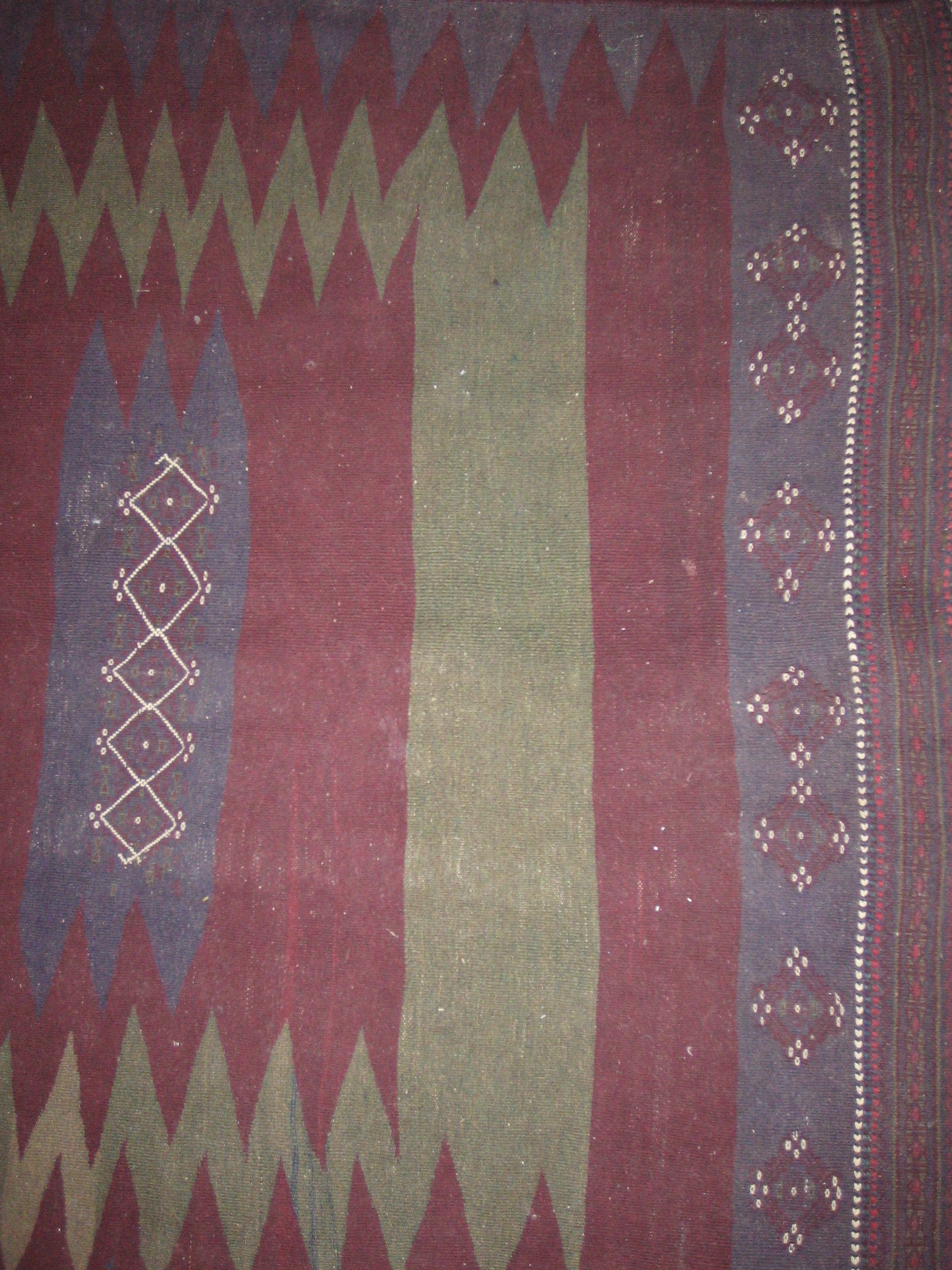
Not every valuable textile is a carpet. The same photo discipline applies to bedcovers, wall hangings, and needlework—different construction, different tells.
Quilts. American pieced and appliqué quilts date through fabric print, colour chemistry, and construction. A Baltimore-style album quilt, a log-cabin, or a Victorian crazy quilt of silk scraps each has a characteristic period. Photograph the full quilt flat, then close-ups of fabrics, quilting stitch length, binding, and any inked signatures or dates. Synthetic fabrics, polyester batting, and machine quilting throughout are later. A hand-quilted top with period prints can still have a later binding—note that honestly.
Woven coverlets. Jacquard coverlets from the 19th century often carry a woven name, date, and place in the corner. That is primary evidence. Photograph the corner inscription and the reverse; double-cloth coverlets look different on each side.
Samplers and embroidery. Alphabet samplers frequently include a name and year. Photograph the whole field, then the inscription, ground fabric, and any fading. Cross-stitch on even-weave linen with a period alphabet is a different object from a 20th-century kit.
Tapestries. European tapestry (Gobelins, Aubusson, Mortlake, and later commercial weaves) is weft-faced: the design is woven, not knotted. Look for slits at colour changes, a ribbed surface, and a plain or lined reverse. Machine-made “tapestry” wall hangings have a printed or mechanically regular back. Photograph the reverse and one selvedge.
Shawls and costume textiles. Kashmir and later European paisley shawls are identified by weave (twill-tapestry versus Jacquard), dye, and border drawing. Costume embroidery, stumpwork, and silk needle paintings need fabric close-ups and any maker or retailer labels.
Navajo and other tapestry-woven blankets. These are weft-faced, usually without knotted pile and often without sewn-on fringe. Regional styles (chief-pattern, storm, pictorial, Ganado) are a specialist field. Photograph both faces, the corners, and any tags. Treat high-value attributions as something to confirm with a textile specialist.
Inherited houses mix all of the above. If you are clearing an estate, a room-by-room photo inventory keeps textiles from being discarded as “old blankets.” See how to identify inherited antiques from photos for that workflow.
Reproductions, “Antique Wash,” and Common Fakes
The rug market is full of honest new pieces sold as decorative—and a smaller number of new pieces sold as old. Learn the common deceptions.
Chemically washed “antiques.” New rugs are bleached or tea-washed to mute colour. The field looks evenly aged, but the back may still look new, the fringes unused, and the foundation un-abraded. If the front says 1890 and the back says last Tuesday, trust the back.
Machine-made “oriental” designs. Power-loom copies of Heriz, Bokhara, and Aubusson patterns are everywhere. Use the handmade-versus-machine checklist: sewn fringe, serged sides, perfectly repeating design, and a back that does not show knot heads.
Label stories. “Silk Tabriz, 18th century” on a paper tag is marketing until structure agrees. Paper retail labels, export stamps, and stencilled numbers can help (they sometimes date a 20th-century shipment), but they do not prove an 18th-century workshop.
Marriages and cut-downs. A border from one rug sewn onto another, or a large carpet cut into runners, is common. Photograph all four sides and the back joins. A sudden change in knot direction, wool, or border rhythm is a join.
A reproduction sold as a reproduction is fine. The problem is the price that assumes age it does not have.
What to Photograph for Identification
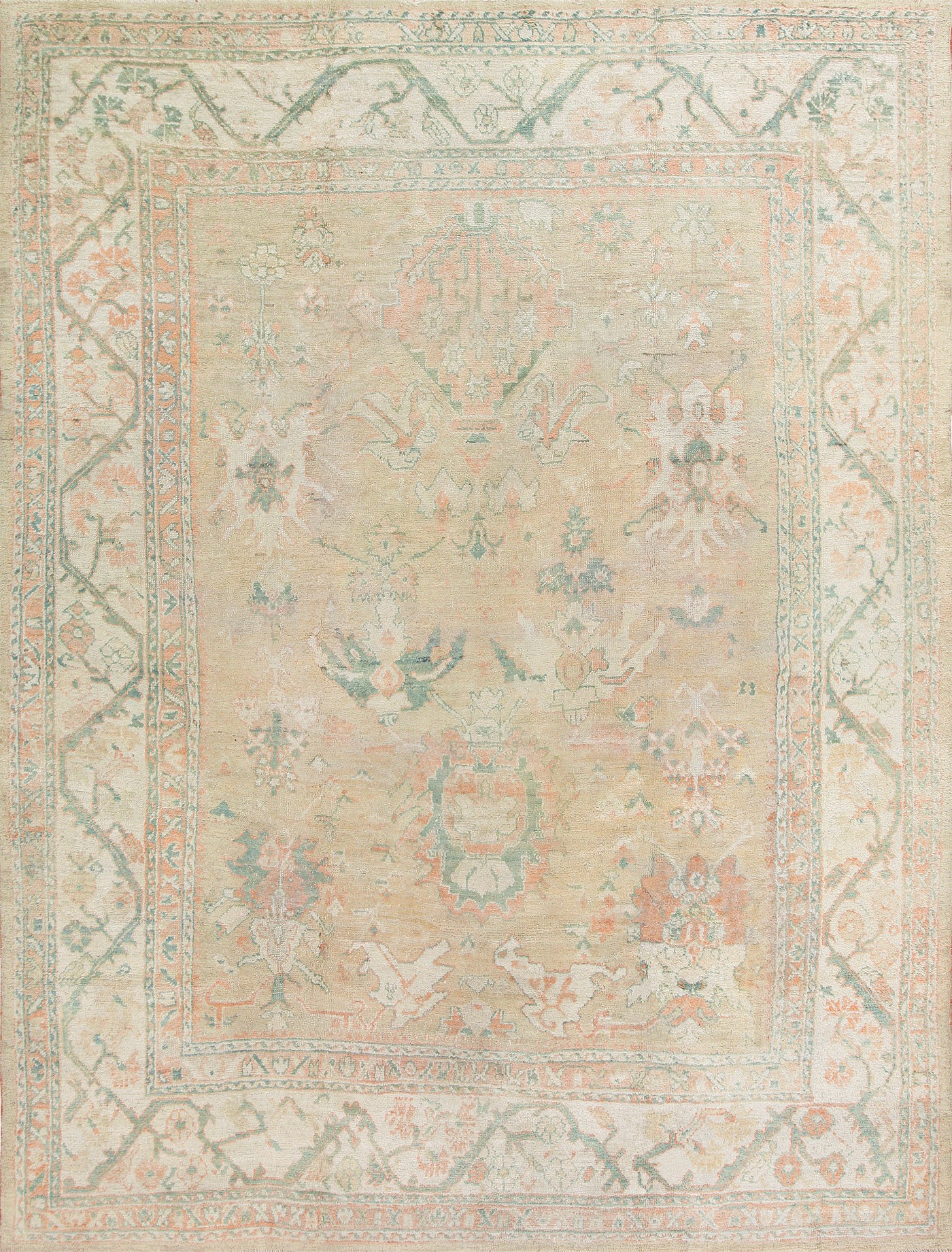
A complete photo set is more useful than one beautiful lifestyle shot. Use this checklist every time:
1. Full piece, overhead. Lay the rug or textile flat (or hang a quilt square to the camera). Include the whole field and borders. Stand above the centre so the rectangle is not a trapezoid. Daylight, no flash.
2. The reverse. Full back plus a fill-the-frame knot or weave close-up. This is the identification photo dealers look at first.
3. Corners and sides. All four corners, both selvages, and both ends. Capture original overcasting versus later recasting, and whether fringe is warp continuation or applied.
4. Pattern details. Medallion, a typical border repeat, and any inscription cartouche (Farsi, Armenian, or woven Latin letters). Inscriptions can name a weaver, a workshop, or a date.
5. Condition. Worn lanes, holes, stains, colour run, moth, and repairs. Honesty here protects you when you sell and speeds a specialist opinion.
6. Scale. A tape measure along one side in at least one frame. Room-size versus scatter size changes both identification and value.
7. Labels and chalk marks. Dealer inventory numbers, export stamps, and old auction tags. Photograph them before you clean anything.
Colour accuracy matters more for textiles than for most furniture. Include a white card or a sheet of printer paper in one frame so pink madder does not read as orange. For lighting and focus technique that applies across categories, see how to photograph an antique for identification.
Using Antique ID for Rugs and Textiles
Once you have the shot list, open Antique ID and upload the overhead view plus the reverse and one corner. The app compares design, structure clues, and visible wear with known types and recent comparable sales, then returns a suggested identification and a market value range.
That range is a research starting point. It helps you decide whether a loft find is a decorative floor covering, a collectible village rug, or something that deserves a textile conservator and a written appraisal. It is not an insurance schedule, a court valuation, or a certificate of authenticity.
Antique ID is especially useful for inherited groups—several rugs, a stack of quilts, a box of samplers—where you need to triage before anything is donated or listed. Upload the best photo set you have, then verify the suggested origin against the back of the piece and a reference book or specialist if the range is high.
For a wider view of photo-based valuation across categories, see how to estimate antique value from a photo. The same honesty rule applies: estimates help you decide; they do not replace a qualified appraiser on high-stakes pieces.
What Drives Value (and What Does Not)
Rug and textile prices move with fashion as well as age. A few constants still hold.
What usually helps value: genuine handmade structure; attractive, well-drawn design; natural or well-aged colour; honest wear rather than holes and dry rot; desirable size (many buyers want room-size carpets that actually fit a room); documented origin; and, for quilts and coverlets, a clear date or maker inscription.
What usually hurts: machine structure sold as hand-knotted; heavy colour run; moth and dry rot; crude patches; cut-down pieces presented as complete; and “silk” that is mercerised cotton or viscose. Size extremes can also limit the market: a palace carpet is hard to house, and a tiny fragment is a study piece, not a floor covering.
What does not prove value: a romantic story with no structure to match it; a single high asking price online; or a label that only says “antique.” Look at sold comparables in the same size, origin, and condition. Asking prices are wishes.
If you plan to sell, match the channel to the piece. Decorative later rugs move on general marketplaces; rare tribal weaves and inscribed coverlets do better with specialist dealers or textile auctions. Pack rolled (pile out for fragile antiques is a specialist debate—ask if the piece is valuable), never fold a brittle foundation, and disclose every repair. Broader selling tactics sit in best antiques to resell.
FAQ: Identifying Antique Rugs and Textiles From Photos
Can you tell if a rug is handmade from a photo?
Usually, if you have a sharp photo of the back and one corner. Handmade pile shows individual knot heads and slight irregularity. Machine-made pieces show even rows, often a sewn-on fringe, and serged sides. A single front-only lifestyle photo is not enough.
What does the back of an oriental rug tell you?
Knot type (symmetrical versus asymmetrical), approximate density, foundation fibre (wool, cotton, silk), repairs, and whether the design is woven through. Dealers often trust the back more than the front because chemical washes and new fringe are harder to hide there.
How can you tell natural dyes from synthetic dyes in a picture?
Natural palettes often show abrash and slightly varied, deep tones. Early aniline dyes can look harsh or fugitive (hot orange, unstable purple, colour that has bled). Lighting must be daylight-balanced. A photo still cannot chemically analyse a fibre—treat dye reading as one clue among several.
Is a kilim an antique rug?
A kilim is a flatweave, not a knotted pile rug. Antique kilims are collectible textiles in their own right. Identify them by slit-tapestry or related flatweave structure, not by looking for pile knots. Photograph both faces—the pattern is usually visible on both sides, with colour reversals.
How do you date an antique quilt from photographs?
Use fabric prints and colours, construction (pieced, appliqué, crazy-quilt silks), quilting stitch, batting, and any inked or embroidered date. Mid-19th-century prints differ from 1930s feedsack cottons and from late-20th-century reproductions. Photograph the whole quilt and several fabric close-ups plus the binding and reverse.
Should I clean a rug before photographing it?
Vacuum gently on a low setting (through a screen if the piece is fragile) so pattern and repairs are visible. Do not wash, bleach, or “brighten” a rug before identification. Water can set colour run and hide the very dye evidence you need. Deeper cleaning waits until you know what you have.
When should I take a rug or textile to a specialist?
When Antique ID or your own research suggests significant value, when silk or inscribed pieces are involved, when you need insurance or probate figures, or when condition problems (moth, dry rot, historic tapestry) need a conservator rather than a high-street cleaner. Photo ID tells you whether that step is worth it.
From Photo Pack to a Confident Identification
Identifying antique rugs and textiles from a photo is a sequence, not a guess. Separate handmade from machine-made. Read the design for a regional hypothesis. Confirm it on the reverse with knot type and foundation. Check dyes and wear for age that matches the story. Apply the same discipline to quilts, coverlets, samplers, and tapestries, which date through fabric and construction rather than pile knots.
Build a complete photo pack: overhead, reverse, corners, details, condition, and scale. Run it through Antique ID for a fast identification and value range, then verify anything high-stakes with a rug dealer, textile historian, or accredited appraiser. Do that consistently and a “nice old carpet” becomes a Heriz with cotton foundation and honest wear—or a later machine copy you can price as décor instead of as an antique.
For other object types, start with how to identify an antique from a photo and keep the same habit: photograph the evidence, then interpret it.
Identify antiques instantly with AI
Use the Antique ID app to photograph items, uncover their history, and estimate value before you buy or list them for sale.
Download Antique IDRelated articles
- How to Photograph an Antique to Identify & Value It Discover expert photography techniques to capture antiques for accurate identification—from lighting and angles to hallmarks that unlock value ranges.
- Antique vs Reproduction: How to Spot the Difference Practical clues that separate genuine antiques from modern reproductions—joinery, wear, marks, materials—and how a clear photo helps you decide what to buy, keep, or skip.
- How to Identify Antiques: Expert Tips to Recognize True Value Learn to read wear patterns, understand historical construction techniques, and decode maker's marks to authenticate antiques like a pro.
- How to Estimate an Antique's Value From a Photo Master the art of photo-based value estimation for antiques—learn what comparables reveal, how condition affects ranges, and when a photo estimate is enough versus when you need a certified appraisal.
- How to Identify Inherited Antiques From Photos: A Room-by-Room Checklist A practical room-by-room guide to identifying and documenting inherited antiques from photos. Avoid costly mistakes, build an inventory, and identify valuable items before house clearance or estate division.
- 7 Best Platforms to Resell for Profit in 2025 Compare eBay, Amazon, Poshmark, and other top marketplaces, plus pro tips to maximise margins on your vintage and collectible finds.